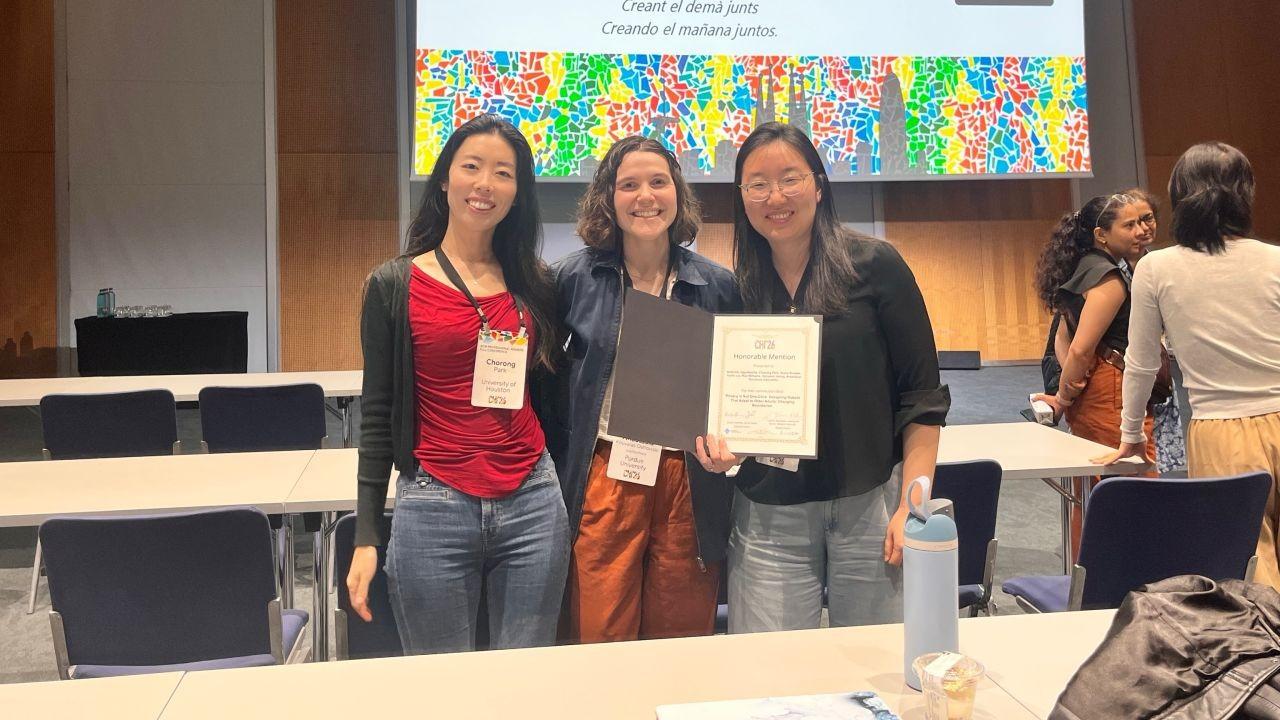
Purdue Polytechnic researchers recently presented two papers in Barcelona at the ACM Conference on Human Factors in Computing Systems (CHI) 2026, one of which earned an honorable mention for their work on the privacy risks associated with social robots and how older adults design social robot privacy features considering these risks. The research team also includes researchers from Purdue Computer Science, and one Purdue Polytechnic alumni, Chorong Park, now teaching at the University of Houston.
CHI is widely considered the most prestigious academic conference in the field of human-computer interaction (HCI). According to this year's conference materials, the 2026 acceptance rate was just 25.3%, with 1,702 papers accepted from 6,730 submissions. CHI ran from April 13 to 17 this year at Barcelona's International Convention Center.
Anastasia Kouvaras Ostrowski, an assistant professor in the School of Applied and Creative Computing (ACC) with a courtesy appointment in the School of Mechanical Engineering, co-authored two accepted projects, which address the growing ethical and logistical challenges of integrating artificial intelligence and robotics into daily life.
One of these papers received an Honorable Mention Award. The award-winning paper, "Privacy is Not One-Click: Designing Robots That Adapt to Older Adults' Changing Boundaries," challenges the standard tech industry model of user agreements. The team of authors was comprised of: Nishchal Jagadeesha; Chorong Park; Avery Kruppe; Yanfu Liu; Rua Mae Williams; Sooyeon Jeong; and Anastasia Kouvaras Ostrowski.
The research argues that traditional privacy notices, which rely on complex legal language, are particularly ineffective for users and that this is also applicable when considering social robots in users' homes. Furthermore, the paper notes that "prior studies often treat physical, informational, psychological, and social privacy as isolated concepts rather than a multidimensional whole.”
To fix this, the Purdue researchers propose moving away from "one-click" consent and toward intuitive, real-time privacy feedback systems that allow users to continually negotiate their boundaries with the robots in their living spaces. The paper was co-authored by several Purdue researchers, including Rua Mae Williams, an assistant professor in ACC, and Sooyeon Jeong, an assistant professor in Computer Science.
A second paper presented at the conference, titled "Bridging Technology and Policy Design," tackled the need for greater collaboration between technologists who build robots and the lawmakers who regulate them. The full authorship list is: Anastasia Kouvaras Ostrowski; Daniella DiPaola; Rylie Spiegel; Zandra H Feland; Zeynep Yalçin; and Cynthia Breazeal
Kouvaras Ostrowski and her co-authors developed the Robot Policy Design Toolkit (RPDT) to facilitate collaboration between the two groups. The research states that "technologies are designed better when they take into account the impact on society, and that policies are more effective when they are grounded in technical knowledge."
The paper argues that legislation is too often written reactively, built around "one mental model of a technology that is already created, rather than legislation and technology being designed concurrently." The RPDT provides a framework for policymakers and HCI practitioners to work together during a robot's development, designing both the technology and its governing policy in parallel.
Common themes emerge across the two projects, as the Purdue authors in these two works emphasized a common requirement for the future of artificial intelligence: developers and policymakers must prioritize adaptable designs and continuous human feedback over rigid, one-size-fits-all automation.
Additional information