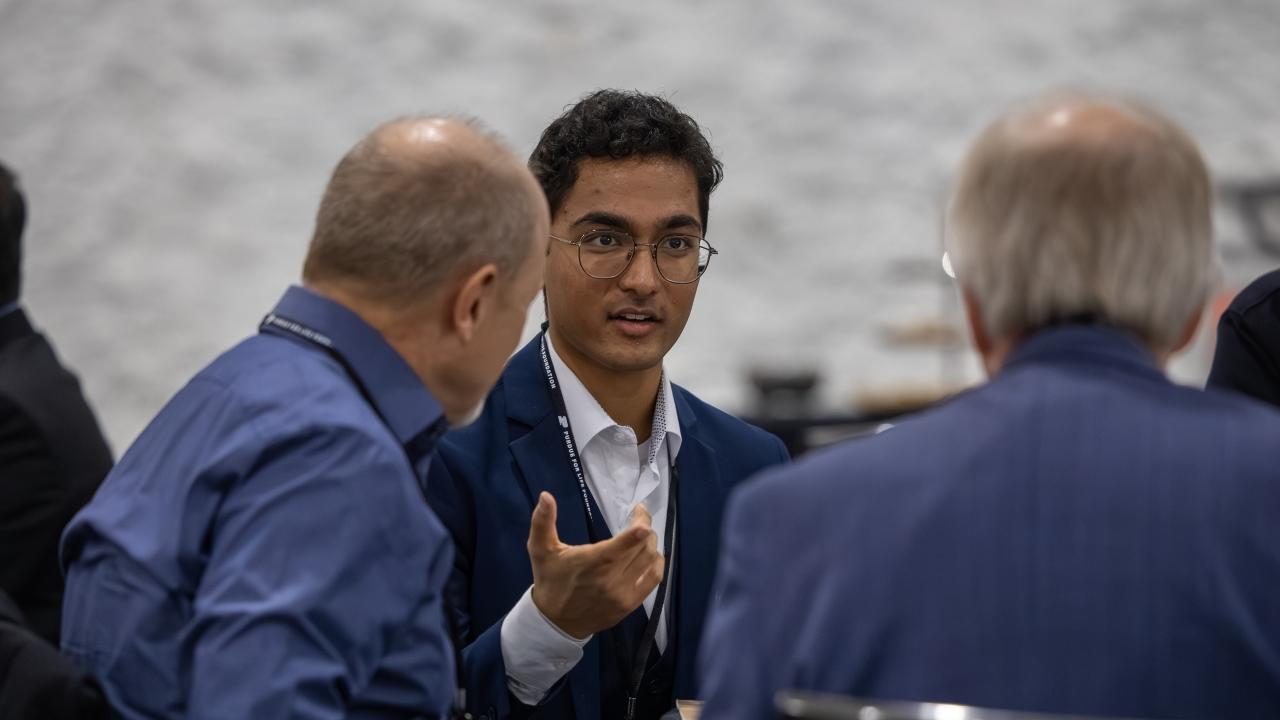
Swastik Patel sees college as more than a pathway to a career-it's also a training ground for the person he wants to become. He's in his final year of the Computer and Information Technology (CIT) major at Purdue, a program within the School of Applied and Creative Computing in Purdue Polytechnic. When Patel graduates in May 2026, he will join Corning, a Fortune 500 company that manufactures Gorilla Glass for iPhones and fiber optic cable for AI data centers.
Patel enjoys programming and theory, but he's equally interested in the application of what he knows. He plans to pursue a career in product management where he can further develop and integrate his technical expertise and business acumen. After all of his internships, interviews and projects, he knows one thing with certainty for the tech industry: how you communicate your systems to stakeholders is just as important as knowing how to build those systems.
“Being able to build various IT systems and programs is positively phenomenal but absolutely meaningless if the way you're describing them causes stakeholders to struggle to comprehend their impact,” Patel said. “CIT has taught me how to explain a complex technical concept at a high level to peers, colleagues and business leaders, especially if they aren't specialized in the same areas.”
College as a place of self-discovery
After graduation, Patel will join the IT Rotational Development Program at Corning, which is designed to give interns experience in functional jobs within the company, including IT, sales, finance, human resources and supply chain. Corning uses the program to develop future industry leaders and help college students and graduates start their careers. Patel hopes this will give him a way to explore the various specialities within IT and find one that aligns best with his interests and desires.
College is ultimately a place of exploration, and Purdue offers several ways to engage in that exploration. Patel's advice for new students is to embrace opportunities to learn new things, adopt a flexible, open mindset, and let yourself be curious about the areas that interest you while you're still in school. He sees the real value of his education being the evolution of himself as a person, especially through obstacles he's faced in the last few years.
Two years ago he attended a weekend retreat that challenged his definition of his value. Organizers led attendees through a discovery process where they explored their professional goals, what mattered to them and their internal motivation to succeed. This process helped Patel realize his value comes from who he becomes along the journey, not from a fleeting moment after he reaches his destination.
“Achieving certain goals in life is wonderful, but they are simply checkpoints on the path of life,” Patel said. “The real value from those milestones comes from what kind of person I become from going through those experiences and surmounting the challenges life brings my way. Identifying my weaknesses, avoiding complacency and maintaining the initiative to keep myself growing for the sake of becoming and remaining a good person is what motivates me throughout all facets of my life.”
A connector of people and communicator at heart, Patel gravitates toward opportunities to help people, whether that's a vision for improving his department's career-readiness and employer engagement efforts or simply being a dependable group member in collaborative projects. His interest in service-focused leadership likely contributed to a major win for a team of Purdue students this year.
Winning a NASA Innovation Award
One of Patel's notable accomplishments as a student was competing in the NASA Spacesuit User Interface Technologies for Students (SUITS) Challenge.
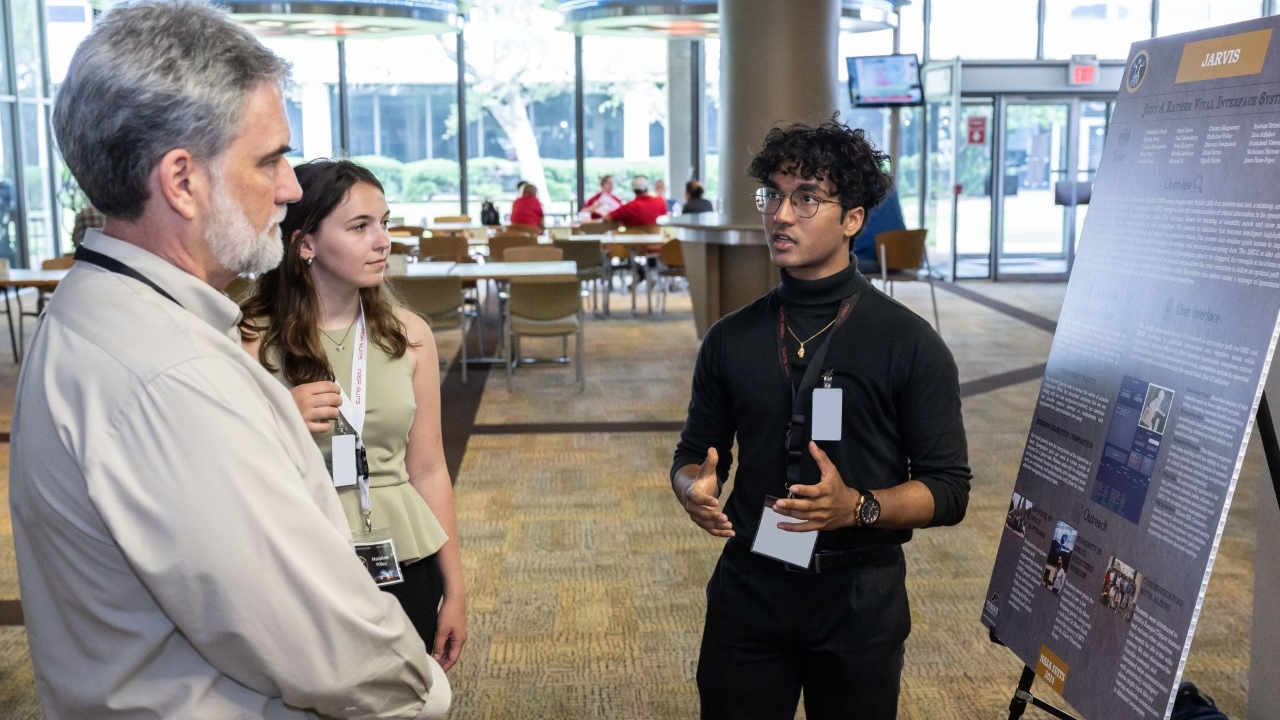
Teams in the NASA SUITS Challenge competed to create new tools that improve how astronauts interact with spacesuits and rovers during planetary exploration. Purdue's team, Team JARVIS (Just a Rather Vital Interface System), won the Innovation Award in the 2025 competition. Team JARVIS developed a user-friendly interface to allow astronauts to control suit functions and rover equipment more intuitively. Patel says this intuitive interface is key for helping astronauts trust the systems they use and learn them quickly.
“I was fortunate to talk with astronaut Deniz Burnham about exactly this, and she mentioned to me that when training for missions up in space, astronauts have to learn everything they would interact with by heart. In a dangerous environment like space, where nearly every decision could result in life or death, astronauts have to be crystal clear about what options are available and how to use them,” Patel said. “Therefore, prioritizing simplicity, customizability and trustworthiness to keep our interface simple, straightforward and scalable was of paramount importance.”
Patel served as both the product and project manager for Purdue's team, leading the goal-setting process at the proposal, design, building and testing stages. He also identified areas for improvement, organized outreach events, handled logistics to get the team to Houston and coordinated with NASA. The experience and the team's award taught him how important the end deliverables are-specifically that a clear vision of the product can guide development and help teams stay on course.
“When working in industry, explaining the utility of what you are building, how it drives value and how it impacts other teams in the short and long run is critical. This knowledge has helped me through my internships, interviews and projects, and even helped me land a job after I graduate in the spring.”
His personal goal before graduation is to make a positive impact on the people around him.
“Throughout my time here, I've been helped tremendously at a personal, professional and academic level by people in leagues above myself in those spheres, so since the start of this academic year, I've been very intentional about helping and giving back to those people, as well as people in whom I see great potential for growth and success.”
Patel wished to thank Purdue professors Josh Plaskoff and Andy Freed and peers Matteo Barrett (CIT) and Sean VandenBussche (DATA) for creating a memorable and rich experience in the classroom and on campus.