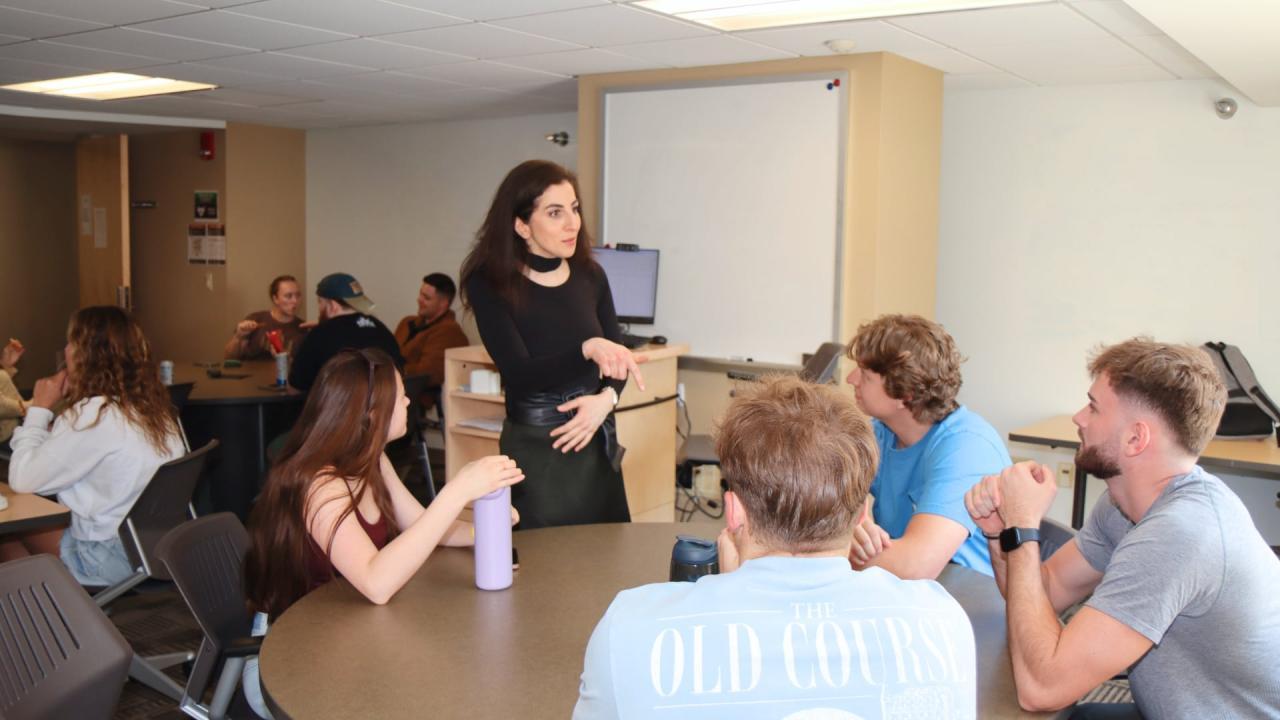
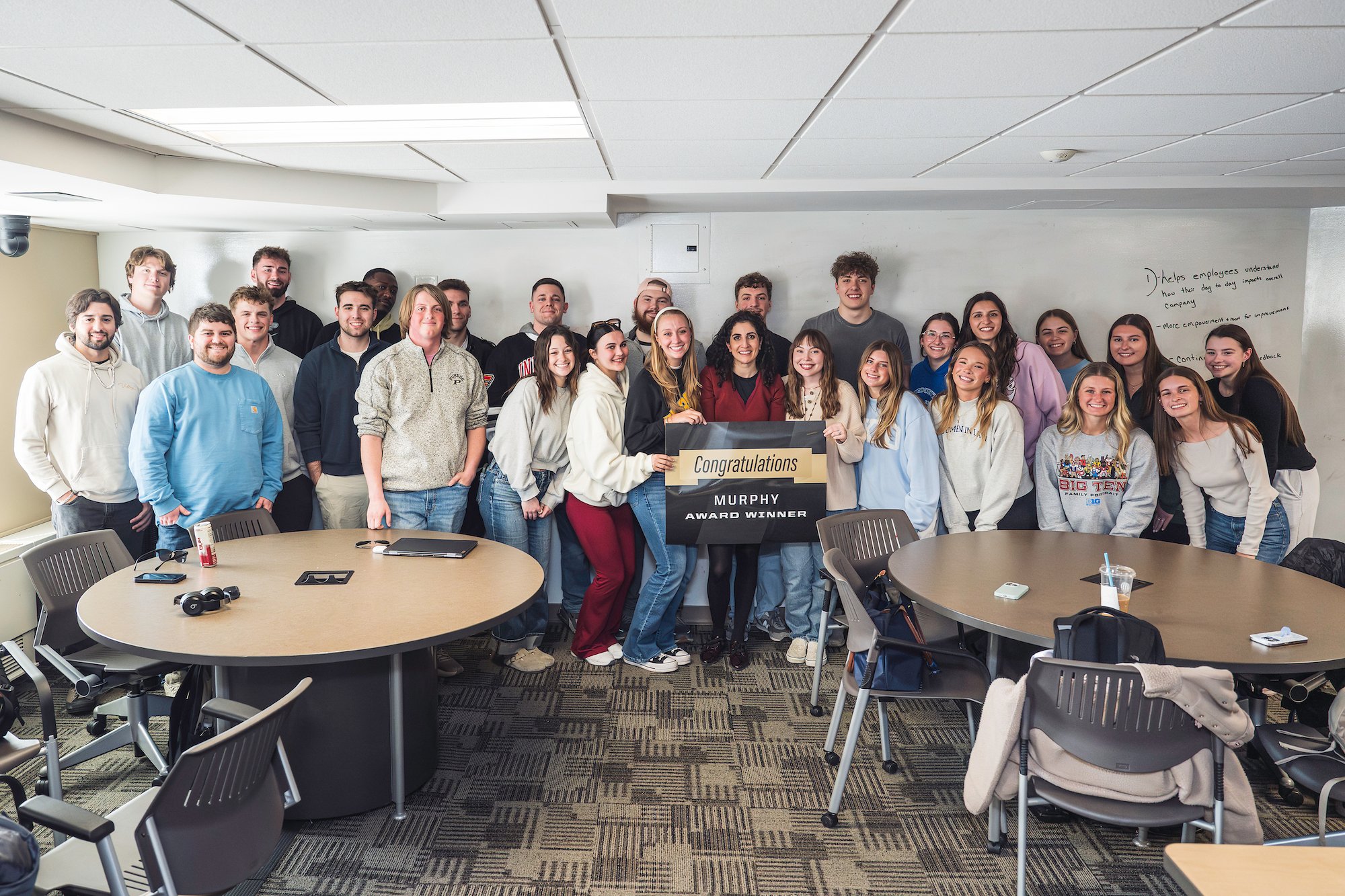
Abrar Hammoud, an associate professor of practice in the Department of Technology Leadership and Innovation, has received the Charles B. Murphy Outstanding Undergraduate Teaching Award for 2026. The award is Purdue University's highest honor for undergraduate education.
Hammoud teaches courses focused on leadership in technology, organizations, and global society. "At the core, I'm trying to help students build the skills to work with people, not around them. And in some ways, that mirrors how I think about teaching, too. It's relational," Hammoud said. "The way we learn how to teach well often comes from engaging with others. Some of the most meaningful growth moments for me came from being able to go to a mentor or colleague and ask, "How do you handle this kind of classroom dynamic?' or 'This didn't land the way I expected-what would you do?' And having people who were willing to share honestly."
While a great deal of her pedagogy has come from seeing what works in the classroom over the years, some of it comes from her own upbringing. "I remember my father used to say to us that nothing can take away the things you learn," Hammoud said. "That idea shaped why I view education as an act of resilience."
Hammoud challenges her students to think beyond the technologies they will build and consider the broader human impact of their work. "A lot of my students are preparing to lead organizations and build the future of technology, but I try to push them to think beyond what they'll build, to who they'll be when what they build changes. We spend a lot of time on things that aren't easily automated: how to have difficult conversations, how to engage across perspectives, and how to think critically without rushing to simple answers."
She prioritizes dialogue and experiential learning over traditional lectures, which she explains is a process of building a trusting classroom environment where students can refine their thinking in community. "I don't want them just to stop at 'this is what I believe.' I want them to dig into, 'why do I believe that? And why might somebody believe something different?' and 'How can I communicate my curiosity to learn more about others' beliefs, with humility?' Hammoud said. "When they leave my class, I want them to be able to say, 'I see the world a little differently now' or 'I handled a conversation differently because of something we discussed."
Hammoud has synthesized her approach to teach from a wide range of influences. In classes covering complexities in the workplace, Hammoud's students study the poetry, music, and lyrics of Tupac Shakur (relating them to the 1964 Civil Rights Act) and Dolly Parton (relating them to the 9-to-5 Movement which aimed to improve women's positions in the workplace). "I want them to wrestle with how laws and social movements evolve over time and to consider what's actually changed, what hasn't, and why. Sometimes the best way into those conversations is through an unexpected lens. It's looking at figures like Shakur and Parton who have very different but equally powerful ways of understanding the same underlying issues."
Since many students in Hammoud's courses will lead in STEM fields, she has made it her aim to encourage thinking across disciplines. In courses about technology and global society, rather than discussing the collaborative qualities of engineering abstractly, she takes students to directly experience those intersections. As they climb through stages and scenery in the Hansen and Mallett theatres, they meet with the Chair of the Department of Theatre and Dance about the interdisciplinary fields that bring performances to life. A behind-the-scenes visit to Mackey Arena with Purdue Athletics' Directors of Technology and Broadcasting allows students to explore how systems of technologies influence athletic performance and fan experience. Through such cross-campus collaborations, Hammoud embeds learning experiences that help students see technology not just as a mechanical system, but as a deeply social one.
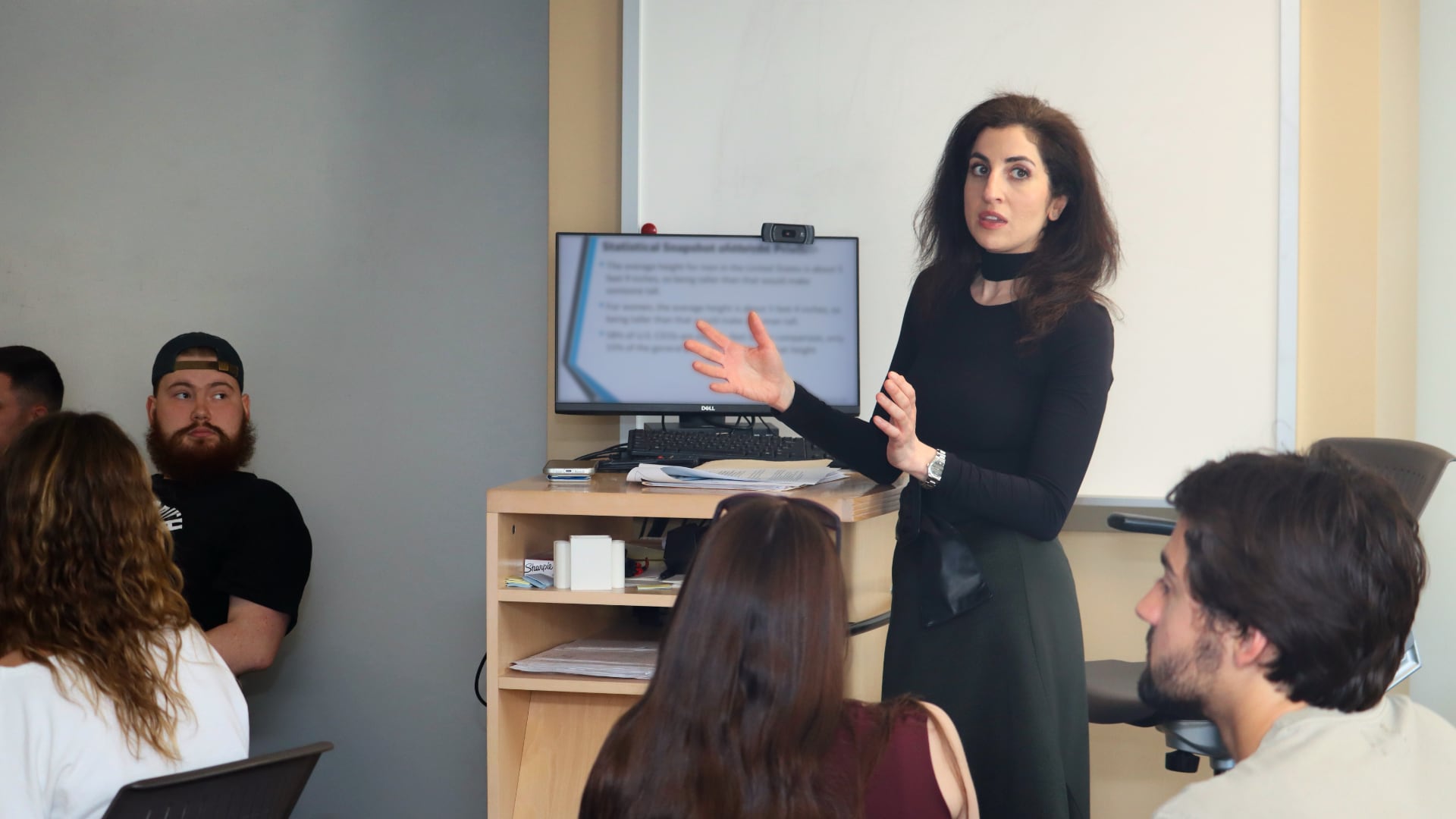
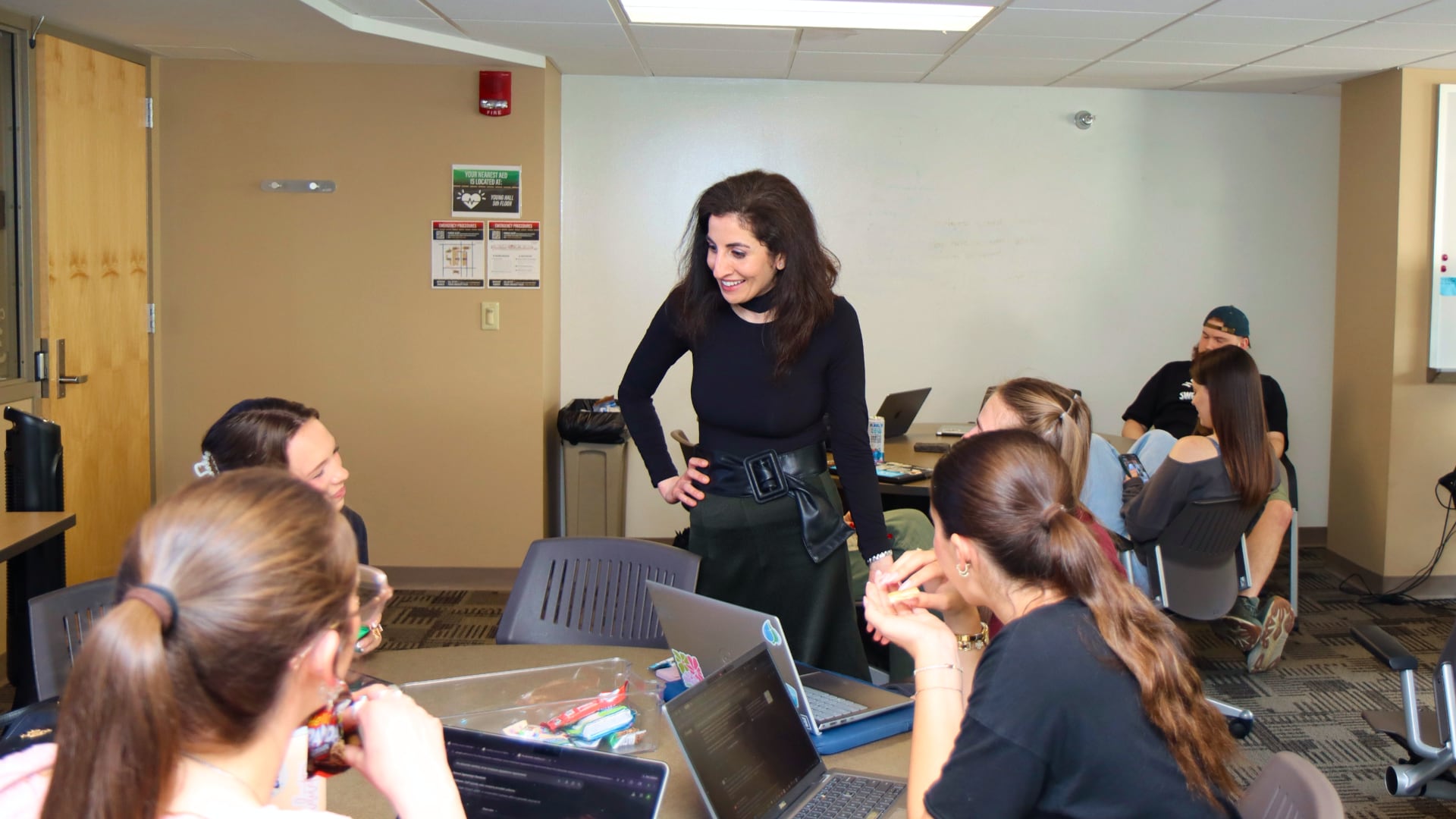

Hammoud's approach underscores that education is not only about what students know, but who they become and how they carry that learning forward. "Students might not remember everything that we teach, but they're going to remember how they experienced learning. I try to make that experience one that stays with them" Hammoud said.
Hammoud views her role as an ongoing process of learning alongside her students and colleagues. "The best instructors I know have people they turn to, and I've tried to both learn from that and create that for others, as well," Hammoud said. For two years, she co-led the Polytechnic's Teaching Excellence Collaborative (TEC), a community of practice that provided teaching mentorship, resources, and support for the college's faculty in the spirit of Purdue's Framework for Teaching Excellence. She explained that her work in faculty teaching mentorship is informed by her research into relational, human-centered approaches to support faculty's teaching. "Faculty's teaching motivation is deeply social," Hammoud said. "And when faculty feel affirmed in their teaching and supported by peers, they're more willing to innovate with their teaching practices."
As she continues her work at Purdue, Hammoud remains dedicated to creating environments where both students and instructors can learn from one another, reinforcing her belief that meaningful teaching is built through connection and community.
Students shared some of the ways that Hammoud's teaching has impacted them:
Ethan Gardner, a Polytechnic student majoring in electrical engineering technology, shared, "Her influence within the classroom is something that I have never experienced before. She has this unique ability to unify an entire classroom of strangers, to learn and engage each other in countless different ways," Gardner said. "She would make everyone feel seen, heard, and understood no matter what difficult situation we were discussing. This ultimately unified the entire classroom of strangers into a classroom of friends and students that understood each other and our ideologies better than when we walked in. … The difference she can make within one semester is something that I have never seen before."
Hadley Beard, a Polytechnic and College of Liberal Arts undergraduate student double-majoring in Organizational Leadership and Law and Society wrote, "I have never felt more seen and empathized with as a unique individual than I have in her classes. Purdue is such a melting pot of individuals from diverse backgrounds, and she approaches each one with grace and kindness. She teaches us so much about the world in new and exciting ways that make me genuinely excited to come to class."
Jordon Lazaro, a student in the Marine Enlisted Commissioning Education Program, shared a similar view.
"She exemplifies the best characteristics of what a professor should be," Lazaro wrote. "She gives so much of herself to her students, which has created a safe space for all of us. She seeks engagement and dialogue constantly to find a way to encourage everyone to participate and bring their unique perspective."
Purdue University grants the Murphy Award annually in the spring semester. The university recognizes up to five faculty members each year as models in excellent undergraduate education.
Additional information