
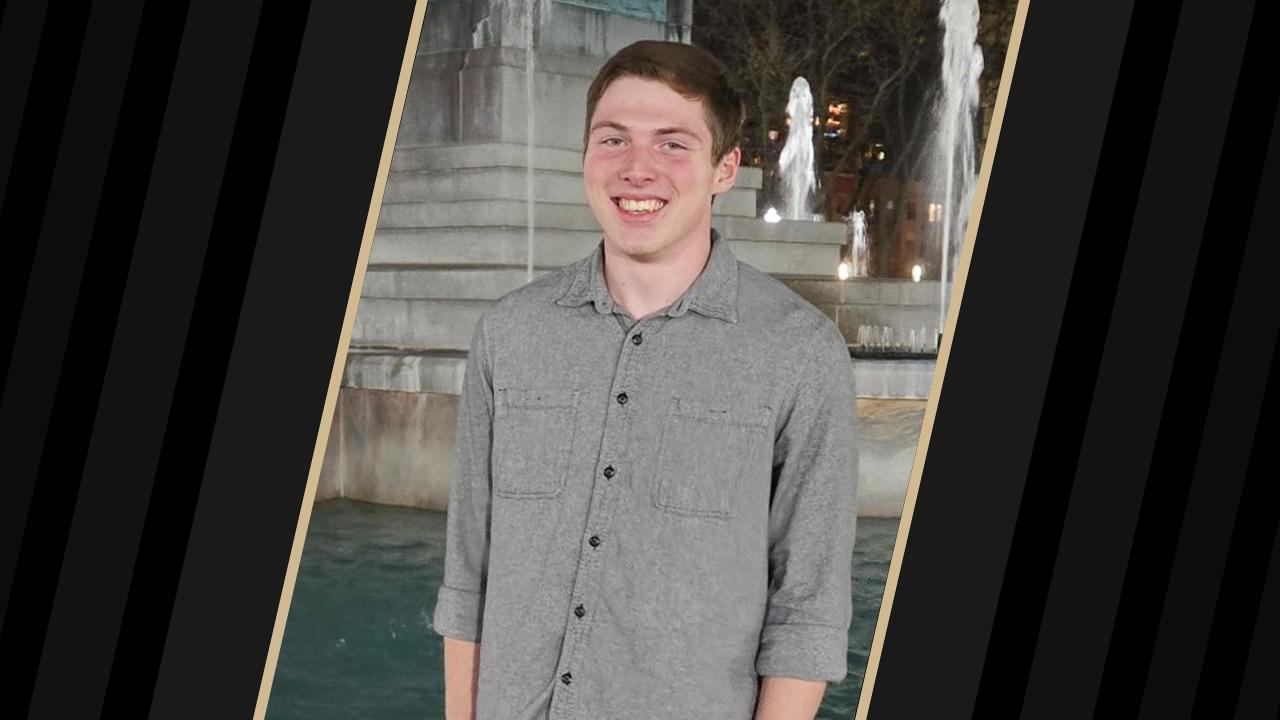
Kaleb Bacztub is sure that his path through cybersecurity at Purdue has been a little "out there."
Bacztub is currently enrolled in a combined bachelor's and master's degree program for cybersecurity in Indianapolis. The curriculum is designed to take five years, but Bacztub has a different plan.
"I am doing a four-plus-one, but I'm doing it in three-plus-one," Bacztub said. "So I'm doing it even faster than normal."
Bacztub is used to taking his education at an accelerated pace. He was already a student who preferred self-teaching, and going beyond the syllabus back in high school-which he also finished faster than normal. He was also in high school when he first became interested in cybersecurity, although it wasn't any particular coursework that sparked that interest.
"My parents got hacked," he said. "My reaction to that was basically, 'That's kind of cool.' So I then pursued the computer science pathway at my high school ... and then I was like, 'I wonder what I could do with that in the future?'"
By the time he arrived in Indianapolis, Bacztub had already obtained his CompTIA Security+ certification, an industry-standard credential usually sought by professionals, not high schoolers. He said this background knowledge made his transition to Purdue unique.
"I was kind of shocked, because I think I was adapting to the expectations of college while I was still in high school."
He hasn't slowed down since arriving on campus. Last summer, he participated in a Research Experience for Undergraduates (REU) at the University of North Carolina. His project involved developing an autonomous AI agent capable of exploiting security vulnerabilities.
"The straightforward way to talk about agentic AI, at least in my use case, is that I basically taught an AI to hack," Bacztub said. "I jokingly said I basically created the Terminator. ... It was very direct-teach an AI to get a hack, a specific exploit-but the important part is that it was fully, fully autonomous. Press one button and it goes through the whole thing."
Bacztub said he worked 8 to 14 hours a day on the project, driven by a specific goal: "I knew that the ultimate goal was to get a paper. And if you didn't work this hard, you probably wouldn't get a paper." His drive paid off when he was finally able to present his work at the Cybersecurity Experimentation and Test conference, and get it accredited by the Institute of Electrical and Electronics Engineers (IEEE).
Bacztub is also a recipient of the National Science Foundation (NSF) CyberCorps Scholarship for Service. The scholarship covers his educational costs in exchange for a commitment to work for the federal government after graduation for at least four years.
The search for connections and opportunities in the government's cybersecurity space is already going well. Bacztub recently landed an internship with ASRC Federal and will spend the upcoming summer working at a Department of Defense missile range in Hawaii. Even getting into the specifics of that role would require a certain level of security clearance, so any news about the specifics of that internship will have to wait.
In the meantime, he is preparing for one of the hardest tests in the industry: the Offensive Security Certified Professional (OSCP) exam. It is a 24-hour practical exam that requires the test-taker to hack into a simulated network.
"It is a pretty difficult one," Bacztub said, noting that many people fail multiple times before passing. "I'm definitely putting the hours in."
For Bacztub, these certifications and degrees are all pieces of a larger strategy to enter the workforce at the highest level of expertise he can possibly manage.
"I definitely have more knowledge than an entry-level guy," he said. "Because in my eyes, entry level is out of college, no certifications, no hands-on experience."
Despite his relentless focus on the next step, Bacztub admits there are moments where he steps back to appreciate the work he's already done.
"Even though it was a really intense schedule, I'm glad I did that research paper. It seems a little crazy to me that I can look up my name on Google Scholar now," Bacztub said. "I think that's really cool."
Additional information