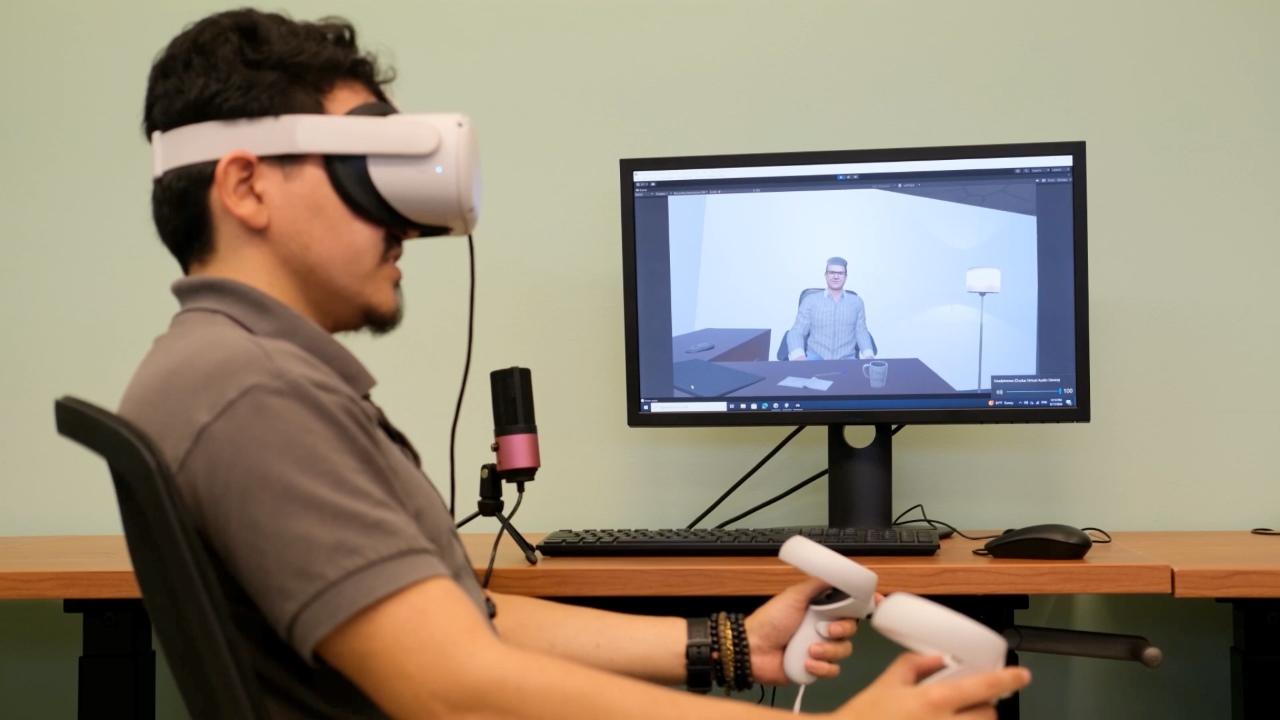
New research from Purdue Polytechnic’s School of Applied and Creative Computing reveals that people are significantly more likely to trust, like, and perceive a virtual agent as knowledgeable if it looks and sounds like someone they know—even when the actual information it provides is exactly the same as an unfamiliar agent.
The study, titled "Exploring Familiarity and Knowledgeability in Conversational Virtual Agents," was published in the ACM Transactions on Applied Perception. The research team was comprised of Ph.D. students Fu-Chia Yang and Siqi Guo, plus associate professor and Virtual Reality Lab director Christos Mousas.
In the study, participants interacted in a virtual reality (VR) environment with two types of AI-driven agents: a "familiar" agent modeled to look and sound like a professor they knew (in this case, game development‘s Robert Howard), and an "unfamiliar" agent with a generic appearance. Both agents were programmed with identical levels of knowledge about game development.
The results showed that when participants interacted with the familiar agent, they rated it as more knowledgeable, trustworthy and likable, regardless of its actual competence.
"From a design perspective, we found that a small number of distinctive personal features were especially effective for creating a sense of familiarity," said Guo. "Things like a participant’s black, thick-framed glasses, a beret, or a very characteristic hairstyle and eye region were cues people immediately used to recognize themselves."
Guo noted that voice was another critical factor. "With voice cloning, many voices... were reproduced quite faithfully," she said. "In practice, once participants heard what they perceived as their own voice, their sense of immersion and familiarity rose noticeably."
The findings have significant implications for the future of AI design, suggesting that familiarity could be a powerful tool for increasing user engagement in fields like education, healthcare, and finance.
"Familiarity can very quickly convey a sense of trust and appropriate authority, which helps students feel more at ease, engage faster and take the content seriously," Guo explained regarding the potential for educational applications. "Similar effects apply in healthcare and finance, where a familiar-feeling agent can support confidence in recommendations and decision making."
However, the study also hints at the power of this psychological shortcut. By simply altering visual and auditory cues to trigger recognition, designers can fundamentally alter a user’s perception of an AI agent’s intelligence and reliability.
Additional information