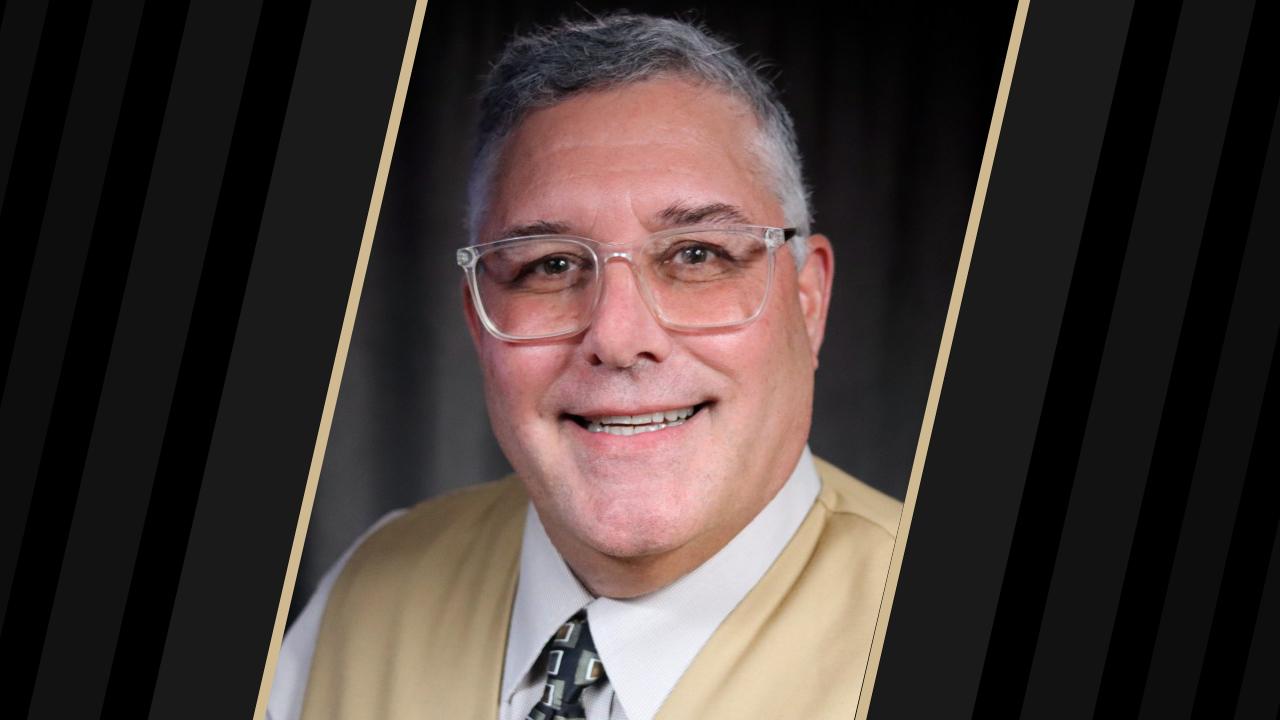
Eric Savage, assistant professor of practice in Purdue Polytechnic's School of Aviation and Transportation Technology, is developing a flight simulator study to examine how pilots' cognitive and physiological responses change as the demands of flying increase.
The work follows Savage's selection for the inaugural Galea Discovery Program through OpenBCI. His project is one of 10 selected for the program's first cohort.
Aircraft provide pilots with a continuous stream of information about airspeed, altitude, heading, engine performance and other operating conditions. Savage wants to develop a similar understanding of what happens to the person operating the aircraft.
“We are trying to add a set of 'human performance instruments' to the simulator,” Savage said. “An airplane already gives us enormous amounts of information about its condition. Yet, we have far fewer objective instruments for understanding the changing conditions of the human being operating it.”
Savage is developing an initial study built around a standardized general aviation flight simulator scenario. Pilots with different levels of experience would fly the same mission, which would include routine portions and periods when demands on the pilot increase.
Researchers would collect physiological and behavioral measurements alongside flight performance data. This would allow them to compare how pilots with different levels of training and experience respond to the same changes in workload.
The proposed study would use Galea, a wearable biosensing platform that can collect several types of data at the same time. These include electrical activity in the brain, cardiovascular response, changes in the skin, muscle activity and eye behavior.
Rather than relying only on a pilot's assessment of how difficult a task felt, researchers could compare those responses with what was happening in the simulator and how the aircraft was being flown.
“I am not expecting Galea to produce a single gauge that suddenly says, 'This pilot has reached the limit,'” Savage said.
Instead, Savage will look for patterns across multiple signals as cognitive demand increases. His goal is to begin defining what he calls a “cognitive operating envelope,” which could provide a clearer picture of the margin between the demands placed on a pilot and the pilot's available mental capacity.
The project is currently in the study development and protocol refinement stage. Savage is working on the simulator scenario, selecting measurements, integrating equipment and preparing for the approval process required for research involving human participants. Equipment validation and preliminary testing will follow.
Savage is collaborating with Sogand Hasanzadeh, associate professor of civil and construction engineering in Purdue's College of Engineering. Hasanzadeh's expertise in human performance, physiological measurement, wearable sensors and data analysis complements Savage's background in aviation operations and human factors.
Their current work centers on developing the research methodology and determining how to combine physiological measurements with flight performance data.
“Aviation has become extraordinarily good at defining the operating envelopes of aircraft,” Savage said. Human performance during changing or demanding conditions, he said, is understood with far less precision.
Savage views the initial simulator study as a starting point. Future research could move into higher-fidelity simulators, more demanding operational scenarios and multi-crew cockpit environments. Undergraduate and graduate students may also have opportunities to assist with simulator operations, data collection, processing and analysis as the research develops.
“We are trying to establish an interdisciplinary capability for studying the human operator with the same experimental rigor that aviation has traditionally applied to aircraft development,” Savage said.