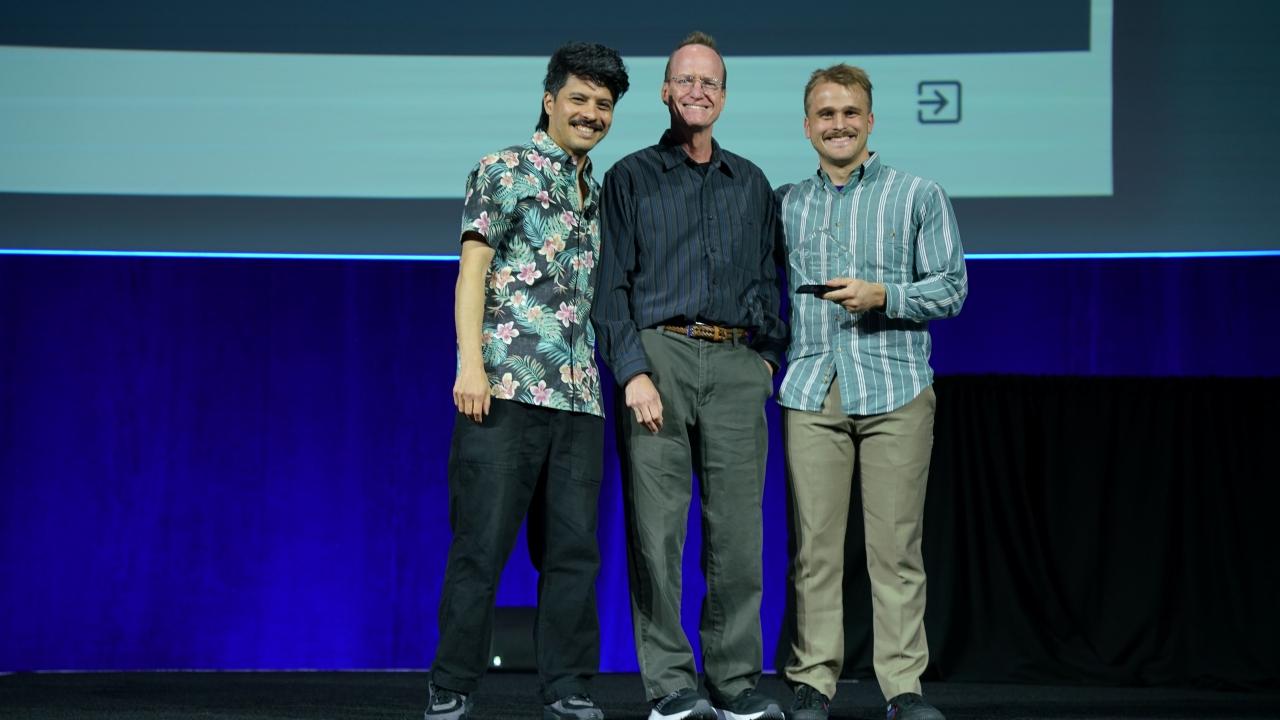
Tim McGraw, an associate professor in the School of Applied and Creative Computing (ACC), and Jack Myers, an ACC master's student, won the Audience Choice award at SIGGRAPH 2026. The researchers showcased their project, "Dissectible Anatomy: Embodied Exploration for Education," during the Real-Time Live event in Los Angeles, California.
SIGGRAPH is a premier international conference for computer graphics and interactive techniques. The Real-Time Live showcase highlights emerging, interactive technologies. More than 3,000 people attended the live presentation, with several thousand more watching via livestream.
McGraw and Myers developed an interactive technique designed to help students learn anatomy without the drawbacks of physical cadaver dissection. Myers noted during the presentation that traditional dissection labs are expensive, require significant space, and rely on toxic preservation chemicals.
The researchers built their virtual model using decades-old data from the National Institutes of Health's "Visible Human Project." The original project froze anatomical donors in gel and cut away millimeter-thin sections to capture complete internal details via color photography. McGraw and Myers used these "cryosection images" as the 3D texture for their interactive model.
The "Dissectible Anatomy" software allows users to interact with the anatomical model without relying on slow biomechanical simulation. The system uses position-based dynamics to maintain stability. The software embeds deformable "splats" between particles controlled by shape constraints, allowing the model to stretch, cut, and tear realistically.
The researchers designed the software to handle complex actions like retracting incisions and separating individual organs. When paired with image segmentation data, the system can display the names and boundaries of specific anatomical structures. Users can physically pull structures away from the main body, prompting the system to create new shape constraints to hold the excised parts.
The technology also functions on standard voxelized 3D meshes, allowing developers to build dissectible models without relying exclusively on cryosection data.
While the researchers do not expect their software to replace physical dissection entirely, they believe the tool can provide students with a safe, accessible way to practice and review anatomy concepts.
Additional information