
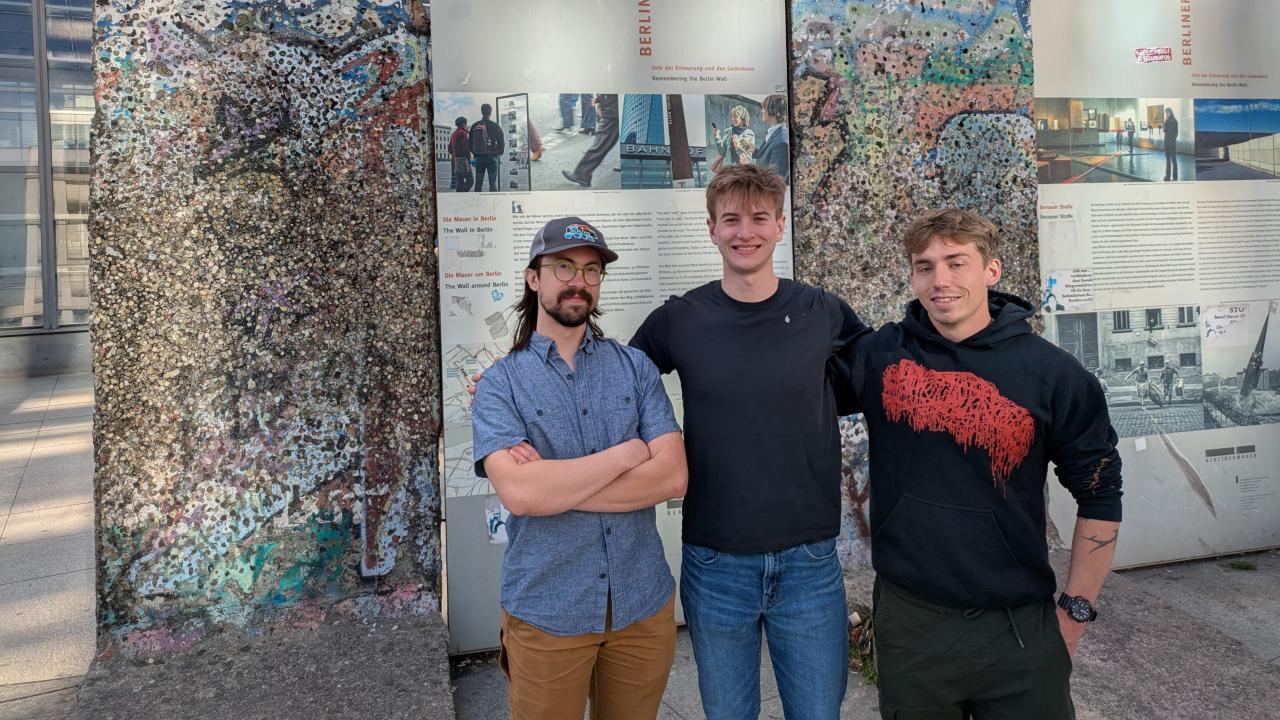
Five Purdue Electrical Engineering Technology (EET) students in Indianapolis recently completed a two-semester capstone project that tested their engineering skills and took them across the Atlantic.
The student team (Hatem Abumadini, Mason Brown, Cody Cox, Ian Means and Devin Tolliver) designed and constructed a fully functional World Cup-themed pinball machine in collaboration with two mechanical engineering students at the Westphalian University of Applied Sciences in Bocholt, Germany.
The German mechanical engineering students designed the pinball machine's frame and the 3D-printed playfield components, including flippers, bumpers, slingshots, targets, and ramps. The Purdue EET students handled the electrical and software integration. Robert Weissbach, a Purdue Polytechnic professor of engineering technology, served as the faculty advisor for the project.
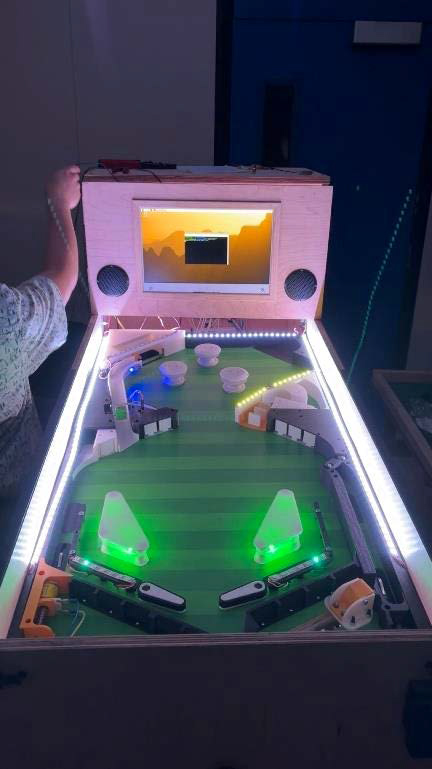
The Purdue team used an embedded Raspberry Pi system to control the machine's display and scoring. A Programmable Logic Controller (PLC) and solid-state relays sent signals between the embedded system and the playfield, ensuring the solenoids mounted within the various components activated safely and accurately. The machine also features a monitor and speakers to display video and audio based on events during gameplay, such as scoring a goal past the machine's automated goalie.
The construction portion of the project cost approximately $3,000, supported by experiential education funding and equipment donations from the EET program.
Following the completion of the machine in April, Weissbach and four of the five Purdue team members traveled to Germany. The trip allowed the Purdue students to present their completed project to the German faculty advisor, Michael Wendland, in Bocholt.
The group then embarked on a nine-day cultural immersion tour across the country. The itinerary included stops in Dusseldorf, Cologne, Mannheim, Garmisch-Partenkirchen, Munich and Berlin. Students visited the 1936 Winter Olympics ski jump in the Alps, toured the Dachau concentration camp memorial, and viewed remnants of the Berlin Wall.
Weissbach said the trip provided students with a geographical and historical montage of Germany and challenged any preconceived assumptions they held about the country.
"This project and trip was a monumental effort for both the students and the faculty advisor," Weissbach said. "The students pushed the limits of their abilities, working together as a team, to complete the design and construction of a full-size pinball machine within the two-semester time frame."
Weissbach plans to use the pinball machine in future capstone design projects. Future student cohorts will have the opportunity to enhance the machine by redesigning the plunger system, modifying the flipper controls and refining the software for video playback and scoring.
A paper detailing the German team's design of the playfield components was accepted for presentation at the American Society for Engineering Education (ASEE) national conference in June 2026. Weissbach anticipates writing a follow-up paper covering the Purdue team's electrical and computer design work for a future conference.
Additional information