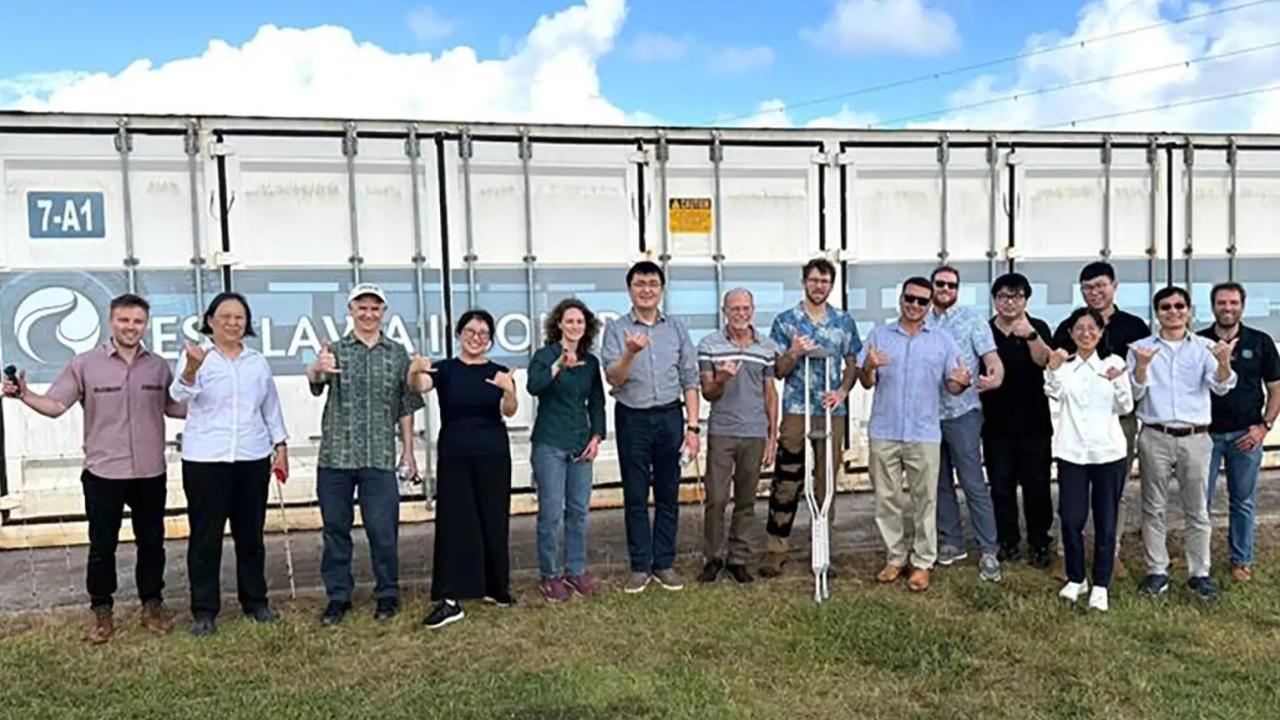
A recent feature from the National Laboratory of the Rockies (NLR) highlights a multi-year effort to stabilize the power grid on the Hawaiian island of Kauai. The project, funded by the U.S. Department of Energy, relied on analytical tools developed by Purdue Polytechnic's Xiaonan Lu to prevent electrical oscillations and potential power outages.
Lu, an associate professor in the School of Engineering Technology with a courtesy appointment in the Elmore Family School of Electrical and Computer Engineering, served as a key subrecipient on the project. He collaborated with the NLR, the Kauai Island Utility Cooperative (KIUC), and other industry partners to address the unique challenges of operating an isolated island grid heavily reliant on inverter-based resources.
Kauai generates a significant portion of its electricity inverter-based generation units. These systems rely on inverters, which use semiconductors rather than the spinning mechanical components found in traditional generators.
As KIUC added more inverters to its system, operators noticed sudden electrical oscillations causing frequency and voltage to wobble across the island. These oscillations threatened to damage equipment and drop customers off the grid.
Lu and his students played a critical role in diagnosing the problem. They developed an oscillation and small-signal stability analysis tool to identify the unique oscillation modes within the island's power grid and determine the root cause of the events.
The analysis, combined with high-fidelity electromagnetic-transient models, allowed the team to pinpoint the specific inverter settings causing the instability. The researchers then tested new "grid-forming" controls on a simulated version of the Kauai grid before validating them in the field.
The new controls proved successful during a subsequent generator trip, completely identifying the electrical oscillations that had previously disrupted the system.
The project has taken important steps in ensuring that modern, power-electronic-based resources can provide the same essential grid strength and stability. The framework developed by the team is now available for other utilities to use as they integrate more inverter-based resources into their own systems.
Additional information
- Read the full story from the National Laboratory of the Rockies: With Inverters, an Island Adapts to Changing Physics of Power Grids