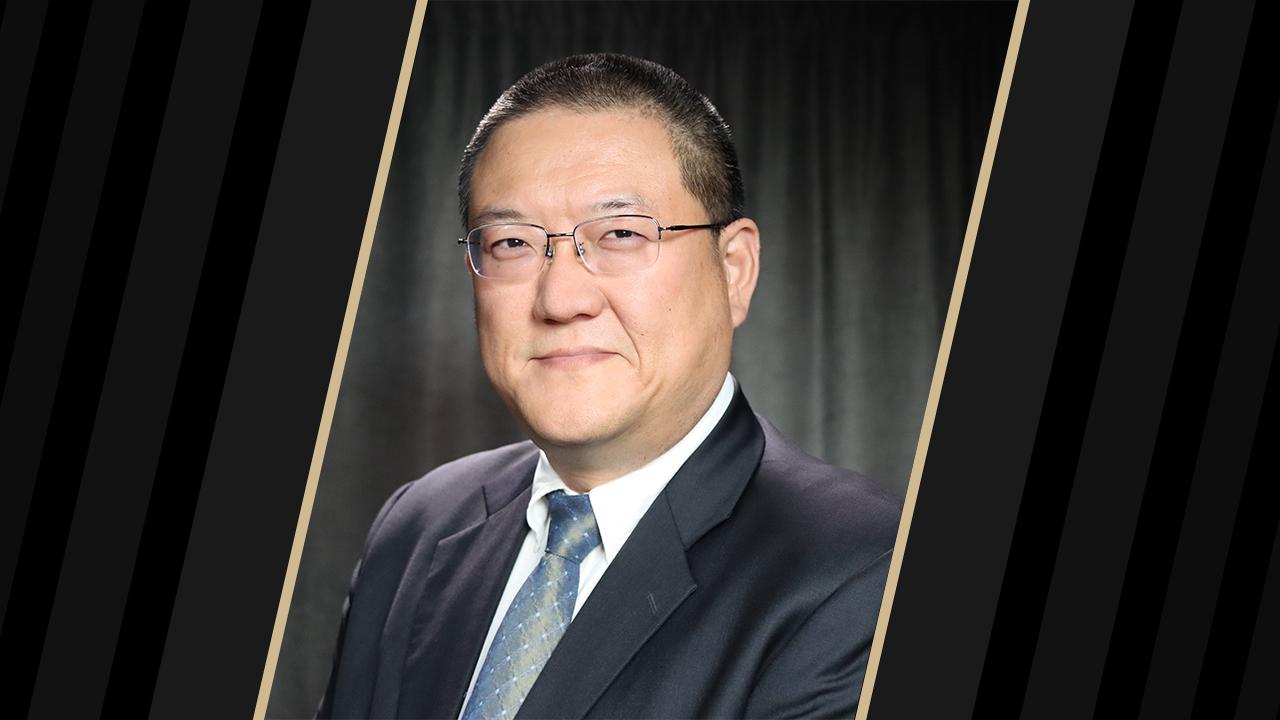
Feng Li begins his first full academic year as head of the School of Applied and Creative Computing (ACC) this fall. The Purdue University Board of Trustees approved his appointment in April 2026. Li steps into the fall semester with a focus on strategic planning and integrating the school's distinct computing disciplines.
ACC combines information technology, networks, cybersecurity, and data on one side, with graphics, design, visualization, game development, animation and user experience on the other. Li wants the school's identity ("Applied Intelligence. Creative Impact.") to serve as a working definition for its students and faculty.
"Applied intelligence means bringing computing to real problems in ways people can trust and actually use," Li said. "Creative impact means pairing that technical depth with design and human understanding, so that what we build is worth using."
Li believes the school has a unique opportunity to merge its distinct computing traditions. He wants students to combine technical system-building with human-centered design.
"Our opportunity is not to keep those two things side by side," Li said. "It is to put them together so that a student can build an intelligent system, judge whether it can be trusted, design the experience around it, and produce work neither tradition would have produced alone."
Li established three primary goals for the academic year. He plans to prioritize faculty and staff support, student success across West Lafayette and Indianapolis, and the practical application of artificial intelligence.
His student success initiatives focus on ensuring course availability, defining clear degree pathways, and improving academic advising to solve immediate student concerns. Li also emphasized his commitment to the people within the school. He plans to ensure new faculty members succeed while maintaining support for the employees who originally built the program.
He views applied AI as a critical component of the curriculum.
"Getting an answer out of an AI system is the easy part now. The hard part is knowing whether to believe it," Li said. "I want our students building these things, breaking them to find where they fail, and able to explain to someone else why a result can be trusted. Sound judgment is what will continue to matter even after the tools change."
These priorities follow a year of internal review. Faculty working groups spent the previous year gathering evidence about ACC programs and research operations. That evidence is the starting point for a five-year strategic planning process.
He emphasized the need for a deliberate and thoughtful approach to this long-term planning. The school will use the gathered data to evaluate current practices and test new concepts.
"We will look honestly at what is changing around us, test ideas at a scale where we can learn from them, and be open about what we keep, change or stop," Li said. "I would rather do that carefully than quickly."
Li noted that ACC operates as a key component of the broader Purdue Computes initiative alongside computer science and electrical and computer engineering. He plans to work with other Polytechnic schools, colleagues across the university, and industry partners to guide the school's growth.
Collaboration remains an absolute requirement for the school's success. He relies on these partnerships to identify the most pressing issues for students to tackle.
"None of this happens alone," Li said. "We do it with our sister schools across Polytechnic, with colleagues elsewhere in the university, and with the industry partners who tell us which problems are actually worth solving. Collaboration is not a courtesy for a school like ours-applied and creative work only proves itself when it meets someone else's real problem."
"The pace has to build people rather than use them up," Li said. "If ACC grows and the students, faculty and staff here are stronger for it, that is the school I want us to become."
Additional information