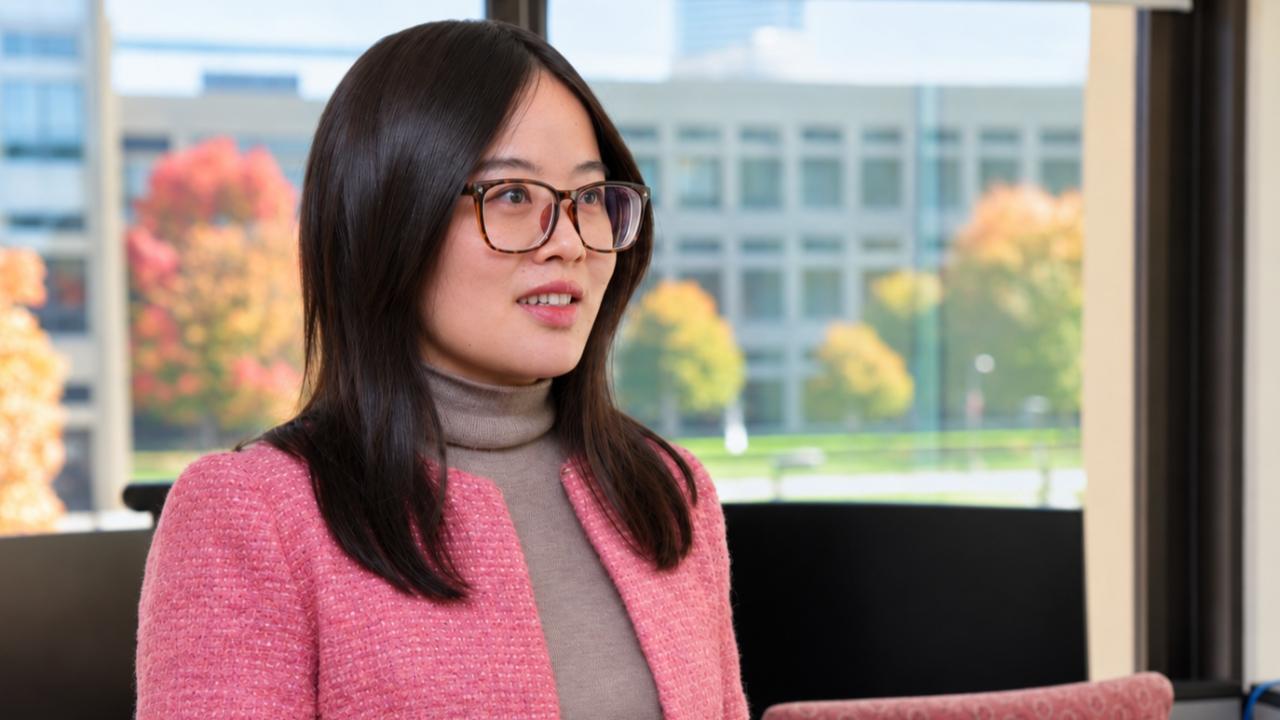
Why do patients with the same disease respond differently to the same treatment? For Qianqian Song, the answer may lie in the complex biological differences among patients, and in the power of artificial intelligence to uncover them.
Song joined Purdue Polytechnic Institute this fall as a tenured associate professor in the School of Applied and Creative Computing. Selected through Purdue University's Moveable Dream Hires program, which attracts accomplished researchers with proven track records, she brings an interdisciplinary research program focused on artificial intelligence, computational biology and precision medicine. She also serves as director of the new Purdue Polytechnic Digital Health Innovation Center.
Song completed part of her doctoral training and later pursued postdoctoral research at Wake Forest School of Medicine, where she began her faculty career before joining the University of Florida College of Medicine. Her experience working alongside biologists, clinicians and computational scientists has shaped a research approach centered on connecting AI innovation with meaningful biomedical questions.
"What works for one patient may not work for another," Song said.
Connecting biomedical insights from cells to patients
Although medical treatments are informed by evidence from large patient populations, individuals with the same diagnosis can have different underlying disease mechanisms and treatment responses. Genetic variations, cellular interactions and changes in disease progression all contribute to these differences.
Song's research seeks to better understand this biological complexity by integrating information from multiple sources, including genomic sequencing, single-cell and spatial transcriptomics, pathology images, medical imaging and electronic health records.
"We need population-level evidence, and we need the individual patient evidence as well," Song said. "We can get complementary insights into the therapeutic design and improve our diagnosis and treatment."
She describes this approach as multiscale precision medicine, developing AI methods to investigate disease from molecular and cellular processes to tissue organization and patient-level outcomes. By studying disease across these different scales, her research seeks to connect biological mechanisms with clinical characteristics and therapeutic responses.
In cancer, even cells within the same tumor can respond differently to treatment. To investigate this variation, Song's team developed SpaRx to examine spatial differences in drug sensitivity, along with DrugFormer and CellPert to predict drug sensitivity and cellular responses to perturbations.
Her more recent research includes three studies published in Nature Communications. The scDrugMap study systematically evaluated foundation models for drug response prediction, while PhenoProfiler developed AI methods that analyze microscopy images to advance image-based drug discovery. Her team also developed MVCBench, a multimodal benchmark for evaluating AI models that predict drug-induced cellular phenotypes, supporting emerging research in AI-powered virtual cells.
Beyond cellular and molecular research, Song also applies computational approaches to understand disease progression and treatment outcomes at the patient level. Her research uses large-scale real-world clinical data to investigate cancer immunotherapy outcomes, including treatment-related adverse events and factors associated with patient risks. She has also integrated genetic information and brain imaging to improve the characterization and interpretation of Alzheimer's disease.
Her patient-focused research has appeared in journals including Journal of Clinical Oncology, Precision Oncology and Advanced Science. These studies demonstrate how computational approaches can uncover clinically relevant patterns from patient data and complement molecular and cellular research in advancing precision medicine.
Her research has resulted in more than 100 peer-reviewed publications and over 30 computational tools and resources. Her work has received substantial support from the National Institutes of Health, as well as state and institutional funding programs. She has led and contributed to multiple externally funded research projects and interdisciplinary collaborations, with research spanning artificial intelligence, computational biology, cancer, drug discovery and precision medicine.
"Ultimately, I want AI to help clinicians answer three questions," Song said. "Why is this patient developing this disease? Which treatment is most likely to work? And how can we predict complications before they occur?"
Advancing interdisciplinary biomedical research through AI
Song's experience working in medical schools has shaped her approach to interdisciplinary biomedical research. Through collaborations with biologists, clinicians and computational scientists, she connects AI methodological innovation with biological questions and clinical needs. Her work spans cancer biology, drug discovery and neurological diseases, reflecting the importance of bringing together expertise from different disciplines to address complex biomedical challenges.
Building new opportunities at Purdue
Building on her interdisciplinary research experience, Song sees Purdue as an opportunity to expand the connections between AI innovation and biomedical discovery. The university's strengths in computing, engineering and interdisciplinary research were major factors in her decision to join Purdue. She cited Purdue Computes and One Health as initiatives that align closely with her research interests and offer opportunities to expand collaborations across disciplines.
As director of the Purdue Polytechnic Digital Health Innovation Center, Song plans to connect expertise in artificial intelligence, biomedical sciences and healthcare to advance research in digital health and precision medicine. She also sees opportunities to collaborate with medical schools, healthcare organizations and pharmaceutical companies through Purdue's growing presence in Indianapolis and across Indiana.
Song also considers education and mentorship central to her role at Purdue. She currently teaches graduate-level bioinformatics computing and systems integration and plans to expand coursework in artificial intelligence and medical informatics. Her teaching emphasizes not only the development of technical skills, but also their application to meaningful scientific and societal challenges.
"One of the most rewarding parts of teaching is helping students connect what they learn in computing with real-world challenges," Song said. "I hope to inspire them to explore how AI can contribute to scientific discovery and create meaningful impact."
Looking ahead, Song hopes to bring advances in artificial intelligence closer to biomedical and clinical applications. She envisions AI helping researchers uncover disease mechanisms, identify promising therapies and translate complex biomedical data into meaningful insights that could ultimately support more informed clinical decisions.
"My vision is a future where AI helps us understand disease earlier, identify better treatments faster and deliver the right care to the right patient at the right time," Song said.
Additional information