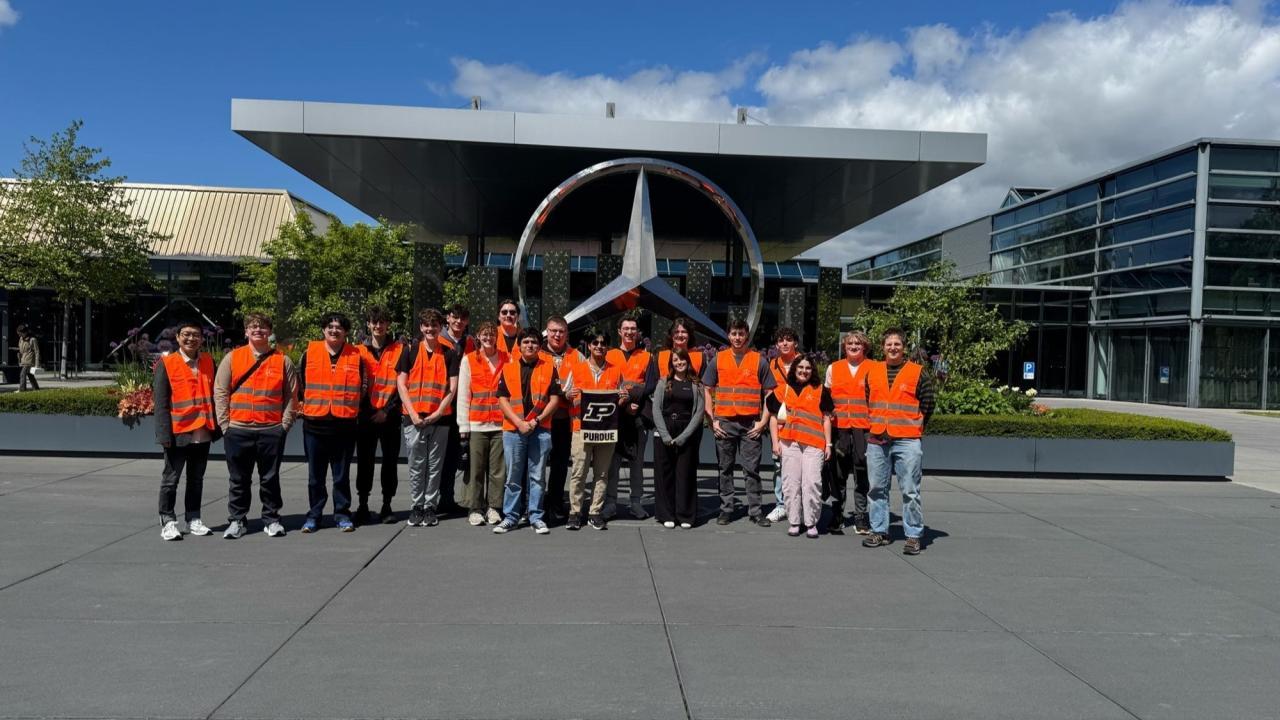
Students from Purdue Polytechnic recently completed a three-credit study abroad course focused on global supply chains and smart manufacturing across Central Europe.
The course, "The Commerce of Cars in Central Europe: From Creation to Cargo," guided students through the complete lifecycle of luxury automobile production and distribution. Jim Tanoos, a clinical associate professor in the School of Engineering Technology, and Dongming Gan, an associate professor in the School of Engineering Technology, led the program.
The curriculum focused heavily on the shift toward collaboration in modern supply chains. The trip explored how the COVID-19 pandemic exposed the fragility of siloed logistics networks, prompting multinational companies to prioritize shared visibility and joint problem-solving.
Students experienced this collaborative approach firsthand during tours of the Porsche, Mercedes-Benz, and BMW production facilities in southern Germany. They observed how luxury automobile manufacturers are integrating Industry 4.0 and smart manufacturing technologies to prevent supply chain bottlenecks. Students noted the increasing use of collaborative robots (also called "cobots"), 3D printing for on-site parts production and real-time data analytics.
The program also took students to the Port of Rotterdam in the Netherlands to observe the cargo distribution phase. The port processes over 300 million metric tons of throughput annually. Students toured the logistics hub by boat and bicycle, learning how terminal operators, shipping lines and port authorities use constant communication and technological integration to maintain smooth cargo handovers.
The trip integrated formal academic seminars with international peers. Purdue students collaborated with MBA students at Hochschule München in Germany for a research seminar on the role of artificial intelligence in cross-cultural business analytics. Later, they worked alongside students from Erasmus University in Rotterdam to analyze the historical supply chain dominance of the Dutch East India Company and its influence on modern maritime law.
Tanoos noted that the cultural immersion extended beyond the classroom. Students navigated the European rail and public transit networks to visit historical and cultural sites. Since Europe's important sites span such a range of history, this included visits to sites like the Mauritshuis Museum in the Hague (which houses Jan Vermeer's Girl with a Pearl Earring), and to the Anne Frank House in Amsterdam-among many other locales important to history both medieval and modern.
"American college students, particularly those studying international logistics networks, benefit from studying on campuses in Europe because living and learning abroad immerses them in diverse cultures, languages and global perspectives," Tanoos said. "It strengthens their adaptability, independence and understanding of an interconnected world."
The group also connected with the university's international network through an alumni event in Amsterdam. A Purdue graduate organized a supply chain-themed scavenger hunt utilizing the city's metro system to conclude the trip.
Additional information