
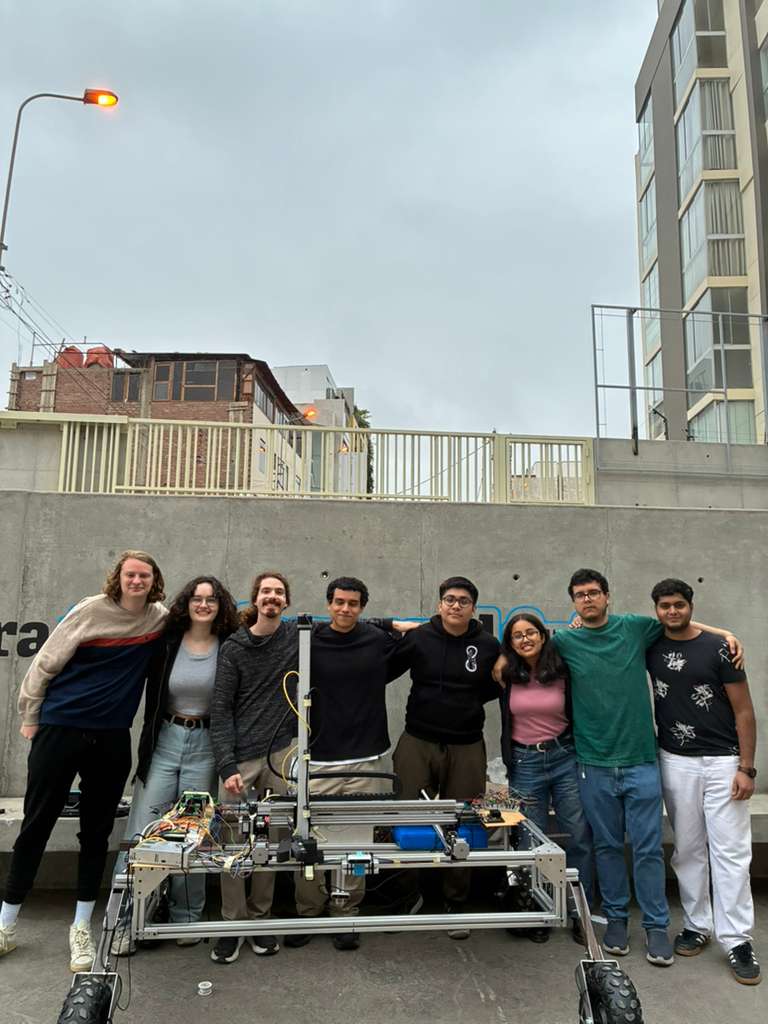
The Asparagus Harvesting Robot is a collaborative capstone project between Purdue University and UTEC (Lima, Peru) focused on automating the harvest of green asparagus in Peruvian fields. The asparagus industry currently depends on slow, physically demanding manual labor that leads to worker fatigue, ergonomic injuries, rising labor costs, and inconsistent product quality. Our project aims to address these issues by designing an autonomous harvesting system that can reliably detect, localize, cut, and collect asparagus spears with minimal human effort, improving both productivity and worker safety.
The final design is an over-the-crops Cartesian robot equipped with a computer vision–guided harvesting mechanism. An Intel RealSense D435 RGB-D camera is mounted close to the ground to capture both color and depth information of the crop rows. The vision pipeline combines classical image processing (HSV color segmentation, pattern recognition, edge detection) with deep learning models (YOLO-based detectors and other CNNs) to identify harvestable spears and convert pixel coordinates into real-world 3D positions through calibration and transformation matrices. These coordinates are used to drive a three-axis Cartesian system, controlled by an Arduino MEGA, that positions a custom end effector. The end effector uses a TPU-based flexible gripper and a cutting blade, each driven by stepper motors, to gently grasp and cut the asparagus without damage. An NVIDIA Jetson module runs the vision and decision-making software in real time, while the UTEC team provides the mobile frame, navigation system, and adjustable wheelbase to adapt to different field conditions. Together, these subsystems form a practical, field-focused platform intended to reduce labor dependency, standardize quality, and demonstrate a realistic path toward autonomous asparagus harvesting.

Peru is world's second largest producer of asparagus, which
contributes greatly to the food supply chain in Peru and many
surrounding countries in South America. There are issues with
asparagus harvesting such as labor shortages,
working conditions, and labor availability that negatively
contribute to the production/supply of fresh asparagus. An
engineered mechanism to aide harvesting could be the
solution to improve production and cost of food.